
Moora Performing Arts Centre 30-32 Padbury Street, Moora, WA
Uploaded By

Featured Theater

Moora, AU
More Photos


Photo Info
Taken on: June 6, 2015
Uploaded on: September 18, 2025
Exposure: 1/15 sec, f/2.2, ISO 500
Camera: Apple iPhone 6
GPS:
-30° 38' 31" S, 116° 0' 28" E
Size: 2.1 MB
Views: 1,576
Full EXIF: View all
Make: Apple
Model: iPhone 6
Exposure time: 1/15
F number: 11/5
Exposure program: 2
ISO speed ratings: 500
Date time original: 2015-06-06 10:59:17 +0000
Date time digitized: 2015-06-06 10:59:17 +0000
Shutter speed value: 1/15
Aperture value: 2.2
Brightness value: 1/2502
Exposure bias value: 0/1
Metering mode: 5
Flash: 16
Focal length: 83/20
Subsec time original: 37
Subsec time digitized: 37
White balance: 0
Focal length in 35mm film: 29
Lens make: Apple
Lens model: iPhone 6 back camera 4.15mm f/2.2
GPS latitude ref: S
GPS latitude: [(30/1), (38/1), (303699/10000)]
GPS longitude ref: E
GPS longitude: [(116/1), (0/1), (70449/2500)]
License:

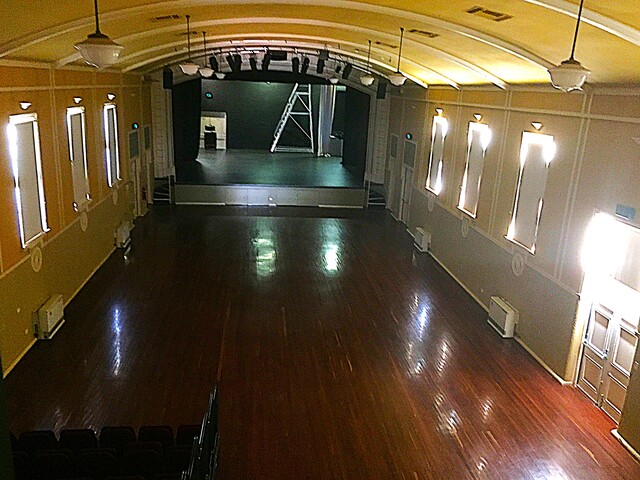
The earliest film screening advertised for Moora was Vincent’s Empire Pictures, screened in November 1908, probably in the Agricultural Hall, known as the Lesser Hall after the new Town Hall was built. The new hall was designed by W. A. Nelson and built by D. W. Griffiths, and was officially opened on 11 June 1913. The Municipal Inventory describes the hall like this:
The entire place is a brick construction with a corrugated iron roof. The front section is the entry foyer, former offices, and associated spaces, behind which is located the hall. The front is classical in proportion with the central entry portico protruding from the front facade. Double classical columns support the portico’s rendered pediment with the name detailed. The building corners are quoined in render in contrast the majority of face brick. The bricks and sandstone were from Griffiths property.
The hall has a sprung timber floor and a stage, making it suitable for many kinds of social gatherings as well as films. In fact, films were not anticipated in the original design, so no provision was made for a bio-box: discussion began in 1916 about the need for one, but it is not clear when it was eventually built, as a fire in 1922 destroyed the relevant municipal records. An early screening at the new Town Hall was The long chance, screened on 9 September 1916. But the first regular screenings were by Mr Flood. Fred Croft (now living in Coorow) remembers being employed by Mr Briggs who ran the screenings in the early twenties, to walk the streets ringing the bell and shouting: “Pictures tonight in Moora Town Hall, the Best of All”.
Moora Hospital Committee was then formed to raise funds for the District Hospital by screening films, but when the hospital came under the control of the State Health Department it was necessary to keep the finances of the voluntary committee separate, to avoid interfering with government grants for the Hospital. So they formed Moora Talkies Committee, conducted screenings in the Town Hall using voluntary labour, and continued to pass on most of the profits to the hospital.
It was the Moora Talkies Committee which started films in the gardens next door, on the south side of the hall. Hall chairs were taken out there when needed, and the children sat on blankets on the couch grass floor. The gardens was surrounded by a high tin wall, and projectors in the hall could be swung round to project through the side windows onto the screen at the south end of the gardens. Screenings took place every Saturday night.
While the Shire generated power for the town, it would close down or break down about 10.30 or 11 p.m., often before the screening was finished. The patrons would then go to the RSL hall and finish the evening with a dance (some-one would always be able to play the piano). This did not happen after the SEC power came to the town in 1970.
Screenings in the hall and gardens continued for about a year after the opening of the drive-in, then ceased, and the gardens was dismantled. The two Raycophone projectors were bought by Graham Ford when he re-opened Meekatharra Open Air in 1988.
In 1993, Vic Basham began to visit the town about once a month in the summer, screening in the hall. These screenings are not as successful as those which Basham provided in Wongan Hills: the Moora hall had poorer acoustics and no heating, and the Moora community had been affected by several tragic events in recent years.
In 1997 the hall was still in excellent condition and in use as a community facility. Moora Talkie Trust also still exists: it has invested the profits from its previous activities, and still distributes the interest around various local charities.
Contributed by Greg Lynch -
 No one has favorited this photo yet