
Alicia Hall West Tamar Highway, Beaconsfield, TAS
Uploaded By

Featured Theater

Beaconsfield, AU
More Photos


Photo Info
Taken on: April 17, 2018
Uploaded on: October 1, 2026
Exposure: 1/400 sec, f/9.0, ISO 400
Camera: NIKON CORPORATION NIKON D750
Size: 467.7 KB
Views: 137
Full EXIF: View all
Make: NIKON CORPORATION
Model: NIKON D750
Artist: Pen Tayler
Copyright: © Pen Tayler
Exposure time: 1/400
F number: 9/1
Exposure program: 1
ISO speed ratings: 400
Date time original: 2018-04-17 14:47:53 +0000
Date time digitized: 2018-04-17 14:47:53 +0000
Shutter speed value: 1/399
Aperture value: 9.0
Exposure bias value: 0/1
Max aperture value: 4/1
Metering mode: 5
Flash: 16
Focal length: 55/1
Subsec time original: 03
Subsec time digitized: 03
White balance: 1
Digital zoom ratio: 1/1
Focal length in 35mm film: 55
Contrast: 0
Saturation: 0
Sharpness: 0
Lens model: 24.0-120.0 mm f/4.0
License:

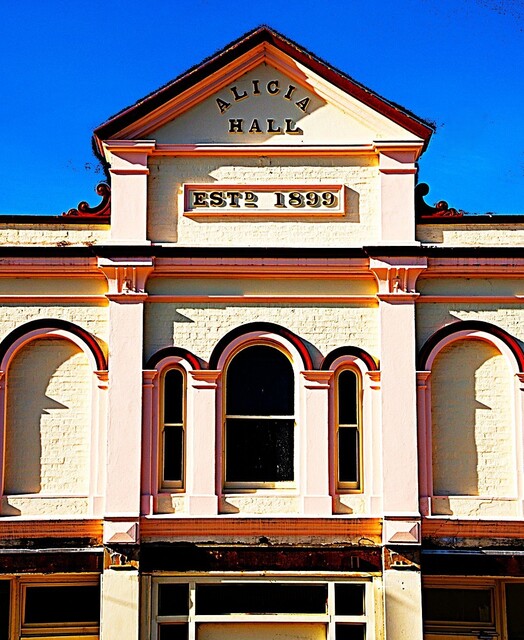
The Alicia Theatre (originally known as Alicia Hall) in #Beaconsfield, Tasmania, is a historic building that served as the central cultural and entertainment hub for the town during its gold mining boom.
Built in 1899 by T.H. Walduck, the hall was named after his daughter, Alicia. Located on Weld Street (West Tamar Highway), it initially operated as a venue for live theatre, community concerts, charity events, and debutante balls. During Beaconsfield’s “Golden Days,” the theatre was a prominent stop for major traveling performers, reportedly hosting legendary opera stars like Dame Nellie Melba and Enrico Caruso.
As the entertainment landscape shifted, the venue transitioned into the home of motion pictures in Beaconsfield:
• 1911: The property was purchased by Annabelle and Frank Cowie, who introduced moving pictures and magic lantern slides.
• 1917: The hall became a flashpoint for local history when it was evacuated due to a bomb scare during a conscription rally.
• 1930s: The theatre adapted to modern technology by installing sound systems for “talkies”. It may have briefly operated under the name Alma Theatre during this era.
• 1947: J.H. (Jack) Bilson purchased the venue, officially renaming it the Beaconsfield Picture Theatre. Under his management,
The theatre later adopted wide-screen CinemaScope technology and continued showing regular film programs well into the late 1950s and 1960s.
Post-Theatre Era & Modern Day
The theatre closed its doors to film screenings in the 1970s, after which the building underwent a variety of commercial uses:
• 1980s: Utilised as an upholstery factory.
Contributed by Greg Lynch -
 No one has favorited this photo yet